
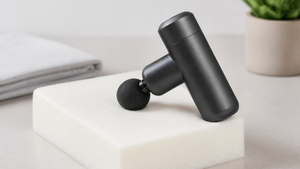

Many first-time massage gun buyers focus on speed or battery life, but one spec often overlooked is stall force. It determines how much pressure the motor can handle before it stops—and that directly affects how deep the massage feels. Without understanding stall force, you might end up with a device that either stalls on your sorest muscles or delivers more force than you need.
This guide explains what stall force is, how it compares to other specs like speed and amplitude, and how to choose the right range for your body and training intensity. We'll also look at a few source-reported examples to help you make sense of the numbers.
What Is Stall Force on a Massage Gun?
Stall force is the amount of pressure a massage gun can withstand before its motor stalls or stops. Measured in pounds, a higher stall force means the gun can keep running against heavier resistance, allowing it to penetrate deeper into muscle tissue. As The Kitchen Pick explains, think of stall force as a boxer's punch power—while amplitude (stroke length) is the reach of the arm. You need both, but without enough force, the punch won't go deep.
It's important to note that stall force is not the same as speed, which is measured in pulses per minute (PPM). A gun with high PPM but low stall force will deliver many light taps, not deep pressure. As Pulse Therapy Hub notes, stall force is a better indicator of how well a massager can work on dense muscle knots. However, Fit Shape cautions that stall force is not the sole factor; technique, attachment choice, and anatomy also play a role.
How Stall Force Compares to Speed and Amplitude
Speed and amplitude are often confused with stall force, but each serves a different purpose. Speed (PPM) controls how fast the head pulses, while amplitude (stroke length) determines how far the head travels. According to The Kitchen Pick, a 30-lb massager at 1500 PPM can outperform a 20-lb one at 3200 PPM for deep tissue work because penetration matters more than frequency. Most users cannot distinguish between 2000 and 2400 PPM, making stall force a more meaningful spec for those who need pressure.
Amplitude and stall force work together: a 10 mm amplitude with 40 lbs of force is roughly equivalent to a 12 mm amplitude with 30 lbs of force in total impact. The source notes that some manufacturers compensate for low stall force with higher speeds, but this is less effective. In short, if you're after deep relief, prioritize stall force and amplitude over raw PPM.
The Risks of Using the Wrong Stall Force
Using too much stall force can do more harm than good. The Kitchen Pick warns that excessive pressure from a high-stall-force gun on an aching muscle may increase soreness or cause injury, potentially leading to lost training time. On the other hand, too little stall force often fails to reach deep knots, leaving users frustrated and the muscle uncompressed.
Other practical trade-offs exist: higher stall force and speed settings drain battery faster, and heavier, more powerful models tend to be noisier and less ergonomic. Fit Shape notes that ergonomics and noise affect safe, comfortable use—especially when reaching shoulder muscles or the middle of the back. Choosing the right stall force is not just about performance; it's about avoiding discomfort and ensuring you'll actually use the device.
How to Pick the Right Stall Force for Your Body and Training
Body type and training intensity are key factors when choosing stall force. The ranges below are source-reported starting points, not rigid rules. Individual tolerance varies, so it's wise to start lower and adjust.
Light and Casual Users (20-30 lbs)
This range feels light and surface-level—ideal for beginners, people with low muscle mass, or those sensitive to pressure. The Kitchen Pick cites the Theragun Mini (20 lbs, $149) as an example. It suits small muscles, light stretching recovery, or users who want a gentle, relaxing massage without deep penetration.
Average Users and Moderate Training (30-40 lbs)
This is a common sweet spot for regular exercisers. It targets moderate knots without being overly aggressive. The Tidesmit Mini Massage Gun offers 30 lbs of stall force in a portable design, fitting the mid-range category nicely. Many users find this range balances depth and comfort for daily use.
Muscular and Strength Athletes (40-50+ lbs)
For very muscular individuals or those with dense tissue, 40 lbs and above provides an aggressive, deep massage. The source highlights the Ekrin B37 (56 lbs, $199) as a high-value option, and the Theragun PRO Plus (60 lbs, $599) sits at the elite end. These levels can work through thick muscles but may be overkill for casual users—so consider your build and recovery needs before jumping to the highest numbers.
FAQ
Can I use a massage gun on sore muscles?
Yes, gentle percussion can help sore muscles, but avoid excessive pressure. A high-stall-force gun used aggressively may worsen soreness or cause discomfort. Start with a low setting and stop if pain increases.
Is a higher stall force always better for deep tissue?
No—higher stall force is not always better. It depends on your muscle density and tolerance. Too much force can cause discomfort or injury, as noted in the risks section. Match the force to your body type and needs.
Does stall force affect battery life?
Yes. Higher stall force and speed settings drain the battery faster. If you need long sessions, consider a model with a larger battery or one that balances stall force with runtime. The source notes this trade-off is common across portable and heavy-duty models.
