
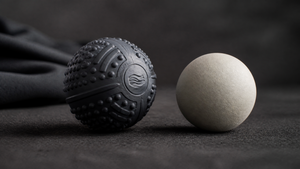

For many people, the daily aches that build up from sitting at a desk or pushing through workouts don’t always warrant a pricey massage appointment. A vibrating massage ball promises a middle ground—something you can use at home, with enough power to work into tight muscle fibers. The Tidesmit Vibrating Massage Ball enters that space with four adjustable intensity levels, positioning itself as a deep tissue option that’s portable and straightforward.
Unlike a static lacrosse ball, the Tidesmit adds motor-driven vibration to the equation. That extra layer of stimulation may help with muscle relaxation and trigger point release, according to source-reported benefits of vibration therapy. But the manufacturer has kept many technical details off the packaging, so it’s worth knowing what you’re getting—and what you’re not—before you buy.
Tidesmit Vibrating Massage Ball: Quick Verdict
The Tidesmit Vibrating Massage Ball stands out for offering four distinct intensity levels in a compact, cordless package. That’s a meaningful step up from single-speed options, giving you the ability to dial in a more targeted pressure for different muscle groups. It’s a tool that seems built for someone who wants adjustability without toting around a larger massage gun or shelling out for regular professional sessions.
That said, the lack of published specs on battery life, weight, and materials leaves a gap. You can’t compare it side-by-side on paper with many competitors. If you’re the type of user who wants to know exactly how long it will run before needing a recharge, you’ll be left guessing. For those who can accept that trade-off, the Tidesmit’s intensity range is a genuine draw.
Who Should Buy the Tidesmit Massage Ball?
Someone who’s tired of pressing a lacrosse ball into a knot and not getting quite enough relief. If you’ve tried static pressure and felt it only went so far, the vibration component may bring a different kind of release. The Tidesmit becomes especially useful when you want to move beyond a single, fixed intensity—you can start low and work up as your muscles adapt.
It may also appeal to people who travel frequently or keep a small gym bag. The ball is self-contained, no cords, and can be used against a wall or on the floor. However, beginners should be cautious with the higher settings. The deep tissue punch can be a lot for sensitive muscles, and the lowest intensity is the smarter place to start. The Tidesmit isn’t the only solution for muscle soreness, but it fills a niche for those who want portable, adjustable vibration without committing to a larger device.
Specs and Deep Tissue Performance
The defining feature here is the four intensity levels. That’s the spec the manufacturer highlights, and it’s the main reason to consider this ball over a simpler model. Each press of the button cycles through the speeds, letting you go from a gentle hum to a more assertive thrum. In the world of vibrating massage balls, that’s not the highest number of settings—some offer five or more—but it’s enough to create a meaningful difference between low and high.
What does “deep tissue” mean in this context? Vibration therapy can stimulate blood flow and help muscles relax, which may ease the sensation of tightness. Sources like livefitguide.com note that portable vibrating balls are intended for muscle recovery, and thewearify.com discusses usage recommendations for targeting trigger points. However, these are source-reported benefits, not guaranteed outcomes. The ball doesn’t physically knead like a therapist’s hands; it relies on oscillating pressure to encourage the muscle to let go.
Beyond the four levels, we don’t have official numbers for battery life, weight, charge time, or shell material. That means you can’t directly compare the Tidesmit to something like the Hypersphere Go’s two-hour battery or the Maxgia’s 9.17-ounce weight. If runtime is a dealbreaker for you, the Tidesmit’s silence on that front is a frustration. On the other hand, the vibration itself is the core experience, and the four-level range gives you room to experiment.
Trade-offs: Potential Drawbacks to Consider
The vibration can be strong. For some users, even the lowest setting may feel aggressive, especially on bony areas like the spine or shoulder blades. Beginners who are new to vibrating massage tools might find the sensation overwhelming. The smart move is to start on the lowest intensity and use it over clothing or a towel until you know how your body reacts.
Because the manufacturer hasn’t released battery specs, you won’t know if the ball will last through a long session or need frequent recharging. Some competing models in the category have their own quirks: an auto-shut off after 10 minutes, a motor that stops after a drop. We can’t say whether the Tidesmit shares those issues without more data. Still, it’s a reminder that durability can vary widely among vibrating massage balls, and a unit with no published track record leaves you trusting the build quality sight unseen.
If you have highly sensitive muscles or a condition that makes deep pressure risky, the Tidesmit might be too intense. A static ball or a lower-power alternative could be a safer starting point. There’s no shame in choosing something gentler; not every tool fits every body.
How It Compares to Other Vibrating Massage Balls
The Tidesmit’s four intensity levels put it in the middle of the pack when it comes to speed options. But other models differentiate themselves with textured surfaces, longer declared battery life, or a wider range of settings. Here’s a quick side-by-side look at how the Tidesmit stacks up against three alternatives, based on what’s known about each.
| Product | Best For | Source-Reported Strength | Caveat |
|---|---|---|---|
| Tidesmit Vibrating Massage Ball | Adjustable intensity | 4 vibration levels | Limited manufacturer specs available |
| Vulken Acusphere | Textured targeted pressure | Textured silicone with massage knobs, auto-shutoff, ~$30 | Auto-shut off after 10 minutes |
| Hyperice Hypersphere Go | Smooth, simple design | 3 speeds, 2-hour battery life | $109, may not deliver deep tissue impact like larger rollers |
| Maxgia 3-Inch 5-Speed | Lightweight travel with 5 speeds | 5 speed options, 9.17 oz, 1.5-hour charge time | No textured surface |
Vulken Acusphere
The Vulken Acusphere, highlighted by HuffPost, uses a textured silicone shell with distinct massage knobs. That design concentrates pressure more than a smooth ball, which can feel more precise against a stubborn knot. It weighs 9.6 ounces and its battery lasts several hours according to reviewer reports, though it does shut off automatically after 10 minutes. At around $30, it’s a budget-friendly pick with a tactile edge—if you don’t mind the timer.
Hyperice Hypersphere Go
The Hyperice Hypersphere Go, covered by thewearify.com, opts for a smooth silicone exterior and three vibration speeds. It weighs a full pound and provides about two hours of battery life. The price tag hovers around $109. That’s a significant jump, and while the build feels premium, the source notes it may not deliver the same deep tissue impact as larger rollers. For someone who values simplicity and a sleek finish, it’s a contender, but the Tidesmit’s fourth speed gives it a bit more room to adjust.
Maxgia 3-Inch 5-Speed Vibrating Massage Ball
The Maxgia 3-Inch 5-Speed Vibrating Massage Ball, listed in both thewearify and livefitguide, stretches the intensity range further with five speed options. It’s lightweight at 9.17 ounces, charges in about 1.5 hours, and its 3-inch diameter makes it highly portable. The trade-off is a smooth surface without the knobby texture of the Vulken. If you’re chasing more granular control over vibration speed, the Maxgia has an edge, but it lacks the tactile grip that some users prefer for myofascial work.
How to Use the Tidesmit Massage Ball
Place the ball between your body and a wall or the floor, letting your weight sink into the muscle. Start on the lowest intensity and roll slowly, pausing on tight spots for 15–30 seconds. You can use it on your back, glutes, feet, or shoulders—pretty much anywhere you’d use a foam roller but with a more focused pressure.
For hard-to-reach areas like the upper back, leaning against a wall with the ball trapped between your shoulder blade and the surface works well. After a few minutes, you can increase the intensity as the muscle warms up. The ball is small enough to toss into a gym bag or suitcase, and sources like livefitguide.com emphasize the portability of these devices for travel and on-the-go recovery. Pairing a session with gentle stretches afterward may help the muscle stay relaxed longer. And if the sensation ever feels too intense, back off—there’s no prize for enduring pain.
