
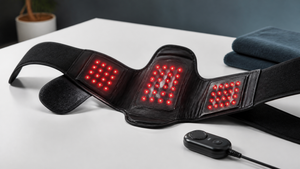

Knee pain doesn't always announce itself dramatically. Sometimes it's just the slow stiffness that settles in after a long walk, or the ache that lingers hours after a workout. For people searching beyond ice packs and NSAIDs, the Tidesmit Red Light Therapy Knee Massager lands in an interesting middle ground — a device that combines heat, vibration massage, and red light therapy into a single wrap designed for the knee joint.
Red light therapy itself has a growing body of research behind it for knee pain, though most studies test clinical-grade panels or lasers, not consumer wraps. The Tidesmit asks a practical question: can a more accessible, multi-function device still deliver enough to be useful? This review walks through what the device offers, what the broader research says, and who might actually benefit from it.
Our Verdict: Is the Tidesmit Knee Massager Worth It?
The Tidesmit knee massager is best understood as a comfort device with some light therapy potential, not a medical-grade treatment tool. Its strongest case sits with people who want gentle heat, vibration massage, and the possible benefits of red light in a single, relatively affordable wrap. The combination of three heating zones and adjustable massage modes offers a sensory experience that many users find soothing for stiff, achy knees — especially after activity or during cold weather.
The main trade-off is power. The device's red light output is not specified in terms of irradiance, which makes it hard to compare against the 40–50 mW/cm² direct-contact wraps or >100 mW/cm² panels that appear in the research. If deep tissue photobiomodulation is your primary goal, a dedicated device with published irradiance numbers may be a better fit. But for someone who prioritizes heat and massage — and sees red light as a bonus — the Tidesmit holds its ground as a practical, low-friction option.
Who Should Use the Tidesmit Knee Massager?
The Tidesmit fits best for people dealing with chronic knee stiffness, post-workout soreness, or general joint discomfort who want a non-pharmaceutical, at-home option. It's a natural pick for someone who's curious about red light therapy but doesn't want to commit to a stationary panel or a higher-priced laser device right away. The fact that it wraps around the knee and delivers heat, massage, and light simultaneously means fewer steps and less setup — a real advantage when motivation is low and pain is high.
Where it's less appropriate: if you're managing a diagnosed condition like moderate-to-severe osteoarthritis and your doctor has recommended photobiomodulation with specific irradiance levels, the Tidesmit may not deliver the intensity needed. Sources like redlighttherapydigest.com and athleticinsight note that dedicated knee wraps with direct-contact LEDs or laser-lens combinations tend to provide more consistent energy delivery to deeper joint structures. A panel used at close range might also cover more surface area if both knees need treatment. The Tidesmit is a supportive tool, not a replacement for medical guidance or physical therapy.
Design and Comfort: What You Need to Know
The Tidesmit wrap uses a soft, flexible material with adjustable straps to secure around the knee. The closure mechanism appears to be Velcro-based, which is common in this category and allows for a degree of size adjustment. How well it fits depends on your leg shape and how tightly you fasten it — a snug fit matters because the red light LEDs and heating elements need consistent proximity to the skin to work effectively.
Comfort during extended wear is a mixed picture. The padding offers some cushioning, but like most wraps, it can shift if you're moving around. For seated use — watching TV, working at a desk, winding down in the evening — it tends to stay in place. During activity, expect some readjustment. Durability is harder to pin down without long-term data, but the Velcro straps are a known wear point across many knee wrap devices. The Tidesmit doesn't feel flimsy, but it's also not built like a piece of medical equipment. It reads as a consumer wellness product, and that's a fair expectation to bring to it.
Heat Therapy and Red Light: How It Works for Knee Pain
The science underlying red light therapy — called photobiomodulation, or PBM — centers on how specific wavelengths of light interact with mitochondria inside cells. The key player is cytochrome c oxidase, an enzyme in the mitochondrial electron transport chain that absorbs red and near-infrared light. When stimulated, it's thought to increase ATP production and modulate inflammatory cytokines, which may help reduce pain and support tissue repair. Dr. Michael Hamblin's work has been foundational in mapping these mechanisms, and the research base has grown substantially in recent years.
A 2024 network meta-analysis published in Aging Clinical and Experimental Research pooled data from 673 participants and found that PBM was associated with improvements in VAS pain scores and KOOS functional outcomes for knee osteoarthritis. Separately, a 2024 systematic review of 10 RCTs involving 542 knee OA patients reported consistent reductions in pain and stiffness. A 2025 RCT in Lasers in Medical Science added further evidence, and an umbrella review of 204 RCTs reinforced the overall direction: PBM appears to help, though the effect size varies with device type, irradiance, and treatment protocol. None of these studies used the Tidesmit specifically.
The Tidesmit combines red light (likely in the 660nm range, though the exact wavelength isn't specified) with deep thermal heat across three zones. Heat alone has its own evidence base for knee stiffness — it increases blood flow and can temporarily loosen tight soft tissue. Layering red light on top of that is a logical pairing, but the absence of a published irradiance spec makes it impossible to know how much light energy actually reaches the joint. A wrap used over clothing or at a slight gap loses effectiveness quickly. For comparison, the FlexBeam delivers 40–50 mW/cm² in direct-contact mode, and some panels exceed 100 mW/cm² at close range. The Tidesmit's output is unverified, so the red light component should be viewed as a potential benefit, not a proven one.
There's also the question of coverage. A knee-specific wrap targets the joint well, but the depth of penetration depends on both wavelength and power. Sources like blog.revgear.com note that wrap-based red light systems can be effective for superficial and mid-depth tissues, but may not reach the meniscus or deeper cartilage as readily as a laser-based device. The Tidesmit's heat is likely the more reliably felt component; the red light is a quieter, less tangible contribution.
Massage Features and Everyday Use
The Tidesmit includes multiple vibration massage modes and adjustable intensity levels, controlled via a simple onboard panel. The vibration is not a deep-tissue percussive massage — it's gentler, closer to a soothing buzz that complements the heat. For post-workout relaxation or loosening up a stiff knee first thing in the morning, it's pleasant and easy to use. The three-zone heating can be set independently, which is useful if you want to focus warmth on one side of the joint.
For a typical session, 15–20 minutes of seated use is a reasonable starting point. The device is corded, which means you need to be near an outlet — a minor inconvenience, but one that limits mobility. The upside is that you never have to worry about a dying battery mid-session. Setup is simple: wrap, adjust the straps, plug in, and select your settings. Cleaning is straightforward too, with a wipe-down surface. Portability is decent for moving from room to room, but the cord means it's not a travel-friendly device in the same way a cordless belt would be.
Alternatives to the Tidesmit Knee Massager
If the Tidesmit's blend of heat, massage, and red light appeals to you but you're unsure about the light therapy component, a few other devices offer different trade-offs. These options come from the broader landscape of knee pain devices reviewed by sources like redlighttherapydigest.com and athleticinsight.com, each with a distinct approach.
FlexBeam – Recharge Health
Direct-contact wrap with targeted red and near-infrared light. The FlexBeam is designed to be worn directly against the skin, with a reported irradiance of 40–50 mW/cm² — a meaningful output for a wearable device. It uses both red and NIR wavelengths, and the skin-contact design means less light loss to distance or fabric. The trade-off is that the battery needs recharging, and some users have noted strap durability concerns over time. For someone who wants red light therapy as the primary function — without heat or massage — the FlexBeam is a focused alternative.
Kineon MOVE+ Pro
Laser and LED combo for deeper tissue penetration. The Kineon MOVE+ Pro takes a different approach by combining 660nm red light LEDs with 808nm infrared laser modules. The lasers, according to source comparisons, provide more focused penetration that may reach deeper knee structures — a potential advantage for targeted issues like cartilage or meniscus concerns. It comes with peer-reviewed clinical research behind it, though the $499 price point and a learning curve for optimal placement put it in a different category than the Tidesmit. This is a higher-investment tool for someone who knows exactly what they're treating.
Hooga Red Light Therapy Belt
Affordable cordless belt with long battery life. The Hooga belt takes a simpler, more flexible approach. At $299, it's positioned as a budget-friendly alternative to higher-end wraps. The cordless design and 150-minute run time, as reported by sources, make it convenient for regular use without being tethered to an outlet. The trade-off is that as a belt, it doesn't contour specifically to the knee — you may need to adjust positioning more than with a dedicated knee wrap. For someone who wants red light therapy across multiple body parts and values portability, the Hooga belt is worth a look.
