
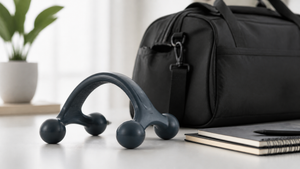

Upper-back tightness from long hours at a desk or on your feet can make you reach for a quick fix—something you can grab without setting up an app or waiting for a battery to charge. The Tidesmit Portable Spinal Massage Tool: 4-Point Deep Tissue Massager positions itself as a manual, no-fuss option that puts pressure directly where you need it.
Unlike electric shiatsu rollers or percussive guns, the Tidesmit relies on its four contact points to deliver deep pressure along the spine. It’s designed to be carried anywhere, so you might keep it in a gym bag or desk drawer for a moment of relief when tension builds.
Verdict: Who Should Consider the Tidesmit Tool
The Tidesmit Portable Spinal Massage Tool may suit people who feel upper-back tightness from prolonged sitting, standing, or poor posture. Its manual, 4-point design targets the paraspinal muscles with steady pressure, which could offer a simple way to work on knots that build up during a long workday.
If you prefer a device that doesn’t need charging and can slip into a carry-on, the Tidesmit’s battery-free, portable nature is a clear advantage. At the same time, it’s not for everyone. Those who need full-back coverage, percussive massage, or adjustable intensity will likely find electric massagers more satisfying. The tool is best seen as a potential aid for muscle relief, not a treatment for chronic conditions.
What Is the Tidesmit Portable Spinal Massage Tool?
The Tidesmit is a handheld, non-electric massager built around four contact points that press into the muscles along the spine. The name spells out the design priorities: portable, spinal-focused, 4-point, and deep tissue. It’s a manual tool, so you control the pressure by how you position and press it.
In the broader back-massager category, this puts it in a different camp than powered shiatsu rollers or percussive guns. The Tidesmit doesn’t vibrate, heat up, or roll. It’s a static, pressure-based device that relies on its shape and your own leverage to deliver a deep-tissue sensation. That simplicity can be a draw for anyone tired of cords, remotes, and charging cycles.
How It May Help with Back Pain
Deep tissue massage, in general, is thought to work by applying sustained pressure to the deeper layers of muscle and fascia, which may help release tension and improve blood flow. The Tidesmit’s four contact points are positioned to target the paraspinal muscles, the long bundles that run alongside the spine and often stiffen from hours of sitting or standing.
Some users of back massagers, as noted in reviews collected by ConsumerHealthDigest, report relief from tightness and soreness with regular use. That’s consistent with what you’d expect from deep-tissue pressure, but it’s not proof that the Tidesmit itself will deliver the same experience. No clinical studies have tested this specific tool, so any potential benefit is theoretical and based on broader massage principles.
How It Compares to Other Back Massagers
Most back massagers today are powered devices, and each type brings a different feel. The Tidesmit’s manual, static pressure stands apart from the heat-and-vibration combo of the Hyperice Venom 2 Back or the rolling nodes of the Chirp RPM Mini, both of which are covered in WIRED’s latest massager guide. The Hypervolt 2, a percussive gun with three speeds and interchangeable heads, offers a rapid, targeted pounding that a simple pressure tool can’t replicate.
Shiatsu rollers like the Snailax, which use kneading nodes and often plug into a wall outlet, provide a broader, more automated massage than the Tidesmit’s focused 4-point design. The trade-off is simplicity: the Tidesmit needs no power, makes no noise, and weighs very little, so it’s easy to toss in a bag. If you want adjustable intensity or a massage that covers your lower back, you’ll likely lean toward a powered alternative. But for a quick, no-setup pressure session on the upper spine, the Tidesmit’s approach can feel refreshingly direct.
Limitations and Potential Drawbacks
Manual massagers like the Tidesmit come with inherent limits. Reaching the lower back can be awkward, and applying consistent pressure requires some physical effort. If you have limited shoulder mobility, you may struggle to position the tool effectively on your own.
The fixed 4-point head means there’s no way to adjust intensity—it feels as firm as the pressure you apply. For some, that could be too intense; for others, it might not feel deep enough. The design also focuses on the spine, so it’s less versatile than devices with interchangeable heads that can tackle shoulders, calves, or feet. And because it’s a manual tool, it doesn’t offer the heat or vibration that many users now expect from a back massager.
FAQ
Is the Tidesmit tool effective for lower back pain?
The tool’s shape is optimized for the spine, so it naturally reaches the mid-to-upper back more easily. You might be able to use it on the lower back with some adjustment, but the lumbar curve can make it tricky to get consistent 4-point contact. It’s not specifically designed for the lumbar region.
How does deep tissue massage work?
Deep tissue massage uses slow, firm pressure to reach the deeper layers of muscle and connective tissue. The idea is to break up adhesions and relieve chronic tension. The Tidesmit’s 4-point design is meant to deliver that focused pressure; whether it achieves the same depth as a therapist’s hands depends on how you use it.
Can I use it on other body parts besides the back?
The 4-point layout may work on larger muscle groups like the thighs or shoulders, but the curved shape is built for the spine, so it won’t fit every contour. Avoid pressing it into bony areas or joints, as deep tissue pressure can be uncomfortable on sensitive spots.
Is it portable enough for travel?
Yes—the name includes “portable,” and since it has no battery, it’s compact and TSA-friendly. It’s likely small enough to fit in a carry-on or gym bag, though exact dimensions aren’t published. That sets it apart from bulkier electric massagers that need charging cables and often take up more space.
