
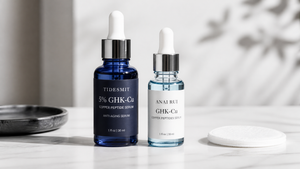

Copper peptide serums have earned a reputation for supporting skin's collagen network and elasticity, but the concentration of GHK-Cu can vary widely. That variance matters when you're comparing the Tidesmit 5% GHK-Cu Copper Peptide Serum and the Anai Rui GHK-Cu Copper Peptides Serum. One pushes the potency envelope; the other takes a more conventional route. Understanding how each fits into a skincare routine starts with the evidence behind the ingredient itself.
GHK-Cu is a naturally occurring copper complex that, in studies, has been linked to procollagen production and visible improvements in fine lines and elasticity. The question isn't whether copper peptides can be beneficial — it's which concentration and formulation aligns with your skin's tolerance and goals.
Quick Decision Summary
These two serums serve different entry points on the copper peptide spectrum. The Tidesmit formula uses a 5% GHK-Cu concentration, which is notably higher than the typical advanced range of 2%. The Anai Rui serum is a standard copper peptide product without a disclosed concentration, but it's positioned as a gentle, skin-barrier-focused option. Your choice hinges on how your skin handles higher concentrations and what kind of intensity you're ready for.
- Choose Tidesmit 5% GHK-Cu if you've used copper peptides before, your skin tolerates stronger actives well, and you're comfortable with the possibility of heightened irritation from a 5% concentration.
- Choose Anai Rui if you're new to copper peptides, have sensitive skin, or prefer a standard formula that still targets wrinkles and barrier strength without the added intensity of a 5% solution.
- General caution: Concentrations above 2% may increase irritation without proportional benefit, so a 5% serum should be introduced gradually and with a patch test.
Key Differences Between Tidesmit and Anai Rui
Tidesmit 5% GHK-Cu Serum: High-Potency Option
A 5% GHK-Cu serum for those targeting visible signs of aging with a higher concentration. The Tidesmit 5% GHK-Cu Copper Peptide Serum sits well above the common 2% ceiling that many sources consider the upper limit of the standard efficacy range. That elevated percentage means the product may be more likely to cause tingling, redness, or irritation, especially for skin that hasn't been conditioned to copper peptides. It's a serum that probably suits experienced users who have already built tolerance and want to see if a higher concentration makes a noticeable difference in their routine.
While general research on GHK-Cu backs its role in collagen synthesis and skin elasticity, those findings come from studies on topical concentrations often around 2%, not 5%. The Tidesmit serum's specific results aren't published, so the potential for stronger effects remains a judgment call rather than a certainty. Still, the bold concentration gives it a clear identity: a product for someone who isn't starting from zero.
Anai Rui Copper Peptides Serum: Standard Formula
A copper peptide serum formulated to soften wrinkles and strengthen the skin barrier. According to a skincare ingredient comparison, the Anai Rui serum focuses on Copper Tripeptide-1 to soften wrinkles and reinforce the skin's protective layer. The exact percentage of GHK-Cu isn't disclosed, but the formula is positioned as a standard option — not a high-potency outlier. That makes it a gentler entry point for someone new to copper peptides or for skin that reacts to more aggressive formulations.
The ingredient list also includes arginine and other supportive components, and the absence of a sky-high concentration means the risk of irritation likely stays lower. Without a published study on this specific product, its benefits are best understood as a reflection of the well-documented GHK-Cu mechanisms, rather than a guaranteed outcome. For many users, the appeal lies in that balance: a research-backed active without the guesswork of a 5% gamble.
How to Choose the Right Copper Peptide Serum for Your Skin
The concentration spectrum for GHK-Cu runs from low (0.5%) to standard (1%) to advanced (2%), and these benchmarks help gauge where a product fits. The 5% strength in the Tidesmit serum exceeds that typical range, which doesn't automatically mean it's better, but it does mean the trade-off between irritation and potential benefit becomes more pronounced. For a closer look at selection criteria, the GHK-Cu Serum Guide offers a breakdown of what to look for in a formula.
If your skin is sensitive or reactive, a lower concentration often makes more sense. The Anai Rui serum, with its undisclosed but likely standard potency, falls into that camp. Experienced users who have already used 2% products without issue might consider the 5% option, but the source-reported pain point is clear: concentrations above 2% may increase irritation without a proportional leap in results. Patch testing and a slow introduction — starting every other night, for instance — can help you gauge whether your skin tolerates the higher dose before committing to daily use.
Safe Application Practices for Copper Peptides
Apply a small amount of GHK-Cu serum to clean, dry skin. If you're using microneedling, a depth of 0.25–0.5mm can help the serum penetrate, but this isn't mandatory. Sunscreen with SPF 30+ is non-negotiable, because UV exposure can undermine the collagen-building effects you're hoping to support.
More isn't faster. Over-application won't accelerate results and may simply lead to product waste or sensitivity. Introduce copper peptides gradually — a couple of times a week, then increase as your skin adjusts. GHK-Cu has minimal side effects compared to retinoids, but combining it with other strong actives like acids or high-percentage retinols still warrants caution. Spacing them out in separate routines gives your skin room to breathe.
Frequently Asked Questions About GHK-Cu Serums
What does the science say about GHK-Cu and skin aging?
The peptide-therapie.de source summarizes studies on GHK-Cu's anti-aging effects. A 1998 study found that 7 out of 10 participants had increased procollagen production and a 30–35% reduction in fine lines. A 2012 study of 67 women showed a 55–70% improvement in skin elasticity after 12 weeks of 2% topical GHK-Cu. These are source-reported results, and individual outcomes vary, but the pattern supports collagen and elastin stimulation as key mechanisms.
Can I use GHK-Cu with vitamin C or retinol?
Direct evidence on combining them is limited, so caution is advised. GHK-Cu has minimal side effects compared to retinoids, but spacing applications and consulting a dermatologist can help you avoid unexpected irritation. There's no hard rule against using them together, just a need for mindful layering and observation of how your skin responds.
What concentration of GHK-Cu is best for beginners?
Beginners typically benefit from starting with a lower concentration, such as 0.5% or 1%. The 5% concentration in the Tidesmit serum is above the typical advanced range of 2% and may be more irritating, so it's best suited for experienced users. A gradual introduction with a standard formula gives your skin time to adjust before considering a higher potency.
