
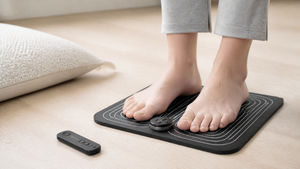

After a long day on your feet, the deep ache that settles into your arches can feel like a fixture of the nightly routine. For many, that discomfort is a signal of tired muscles and sluggish circulation. Electrical muscle stimulation (EMS) foot massagers have emerged as a hands-free approach to addressing that fatigue, delivering gentle pulses to the soles without the need for manual kneading or rolling.
The Tidesmit EMS Foot Massager Pulse Relief is one such device, designed to sit on the floor while you recline and let programmed electrical signals do the work. But how does a mat of electrodes translate into a feeling of relief, and what does the evidence actually say about the benefits? The answer lies in the way the body's nerves and muscles respond to low-level electrical impulses.
What Is EMS Technology and How Does It Work?
EMS technology sends controlled electrical impulses through the skin to trigger muscle contractions. In the feet and lower legs, these impulses target the nerve pathways that control movement, causing muscles to tense and release rhythmically without any voluntary effort from the user. The source at Lindalia explains that this passive stimulation can engage the soleus muscle, the deep calf muscle often called the "second heart" because it helps pump blood back up toward the torso.
A related mechanism, the gate-control theory of pain, helps explain why these impulses may also reduce discomfort. According to Rawlogy, both EMS and TENS (transcutaneous electrical nerve stimulation) use this principle: the electrical signals travel faster than pain signals along the same nerve pathways, essentially closing the "gate" in the spinal cord so that fewer pain messages reach the brain. While TENS is geared toward nerve stimulation for pain relief, EMS focuses on muscle contraction. In practice, the sensation is a tingling, pulsing rhythm that many describe as a deep, involuntary massage.
What the Evidence Says About EMS Foot Massager Benefits
Evidence on EMS foot massagers draws mostly from physiological principles and small-scale observations rather than large clinical trials. Still, the available data points to a few practical benefits worth considering.
One of the more striking comparisons comes from the Lindalia source, which notes that 10 minutes of EMS foot massage at a moderate intensity can produce roughly the same lower-leg circulation boost as 20 to 30 minutes of moderate walking. For someone stuck at a desk or recovering from an injury, using a device like the Tidesmit EMS Foot Massager might offer a passive way to encourage blood flow. The muscle contractions act like a pump, squeezing the veins in the lower leg and helping move blood back toward the heart.
Swelling, or edema, is another common complaint, especially after prolonged sitting or standing. The same source describes a useful combination: when you pair active pumping from EMS with gravity assistance—simply elevating your feet—the reduction in swelling can be about twice as great as with either method alone. That's a practical insight for anyone who props their feet up after a long day.
The gate-control mechanism also applies to pain. Both EMS and TENS use this pathway to reduce the perception of pain signals, though EMS is primarily a muscle stimulator. This means the device may temporarily dial down the discomfort from tired, aching feet.
For people with neuropathy, particularly diabetic neuropathy, the symptoms of burning, tingling, and numbness can be persistent. The Lindalia article suggests that EMS may help manage these sensations, but it's careful to say that EMS does not treat or cure the underlying condition. It's a symptom management tool, not a medical fix. If you're dealing with nerve-related pain, a conversation with your doctor is a smart first step.
What to Look for in an EMS Foot Massager
Choosing an EMS foot massager comes down to how much control you want over the experience and how the device fits into your routine. A few features make a noticeable difference.
Mode and intensity settings are the core of customization. The Rawlogy EMS Foot Massager Pro, for example, offers 10 massage modes and 20 intensity levels. That range lets you shift from a light, fluttering sensation to a deeper, more insistent pulse. More modes can mimic different massage styles—kneading, tapping, shiatsu—while more intensity steps give you finer control, which is especially helpful if your feet are sensitive or you're new to EMS.
A remote control is more than a luxury. It means you can adjust settings without bending over or interrupting a relaxed position. For anyone with mobility issues, that small convenience can be the difference between using the device regularly and letting it collect dust.
Session duration advice from the source is consistent: 20 to 30 minutes per session is recommended. This prevents overuse and gives muscles time to respond without fatigue. Some devices have an auto-shutoff, which is a plus.
Electrode placement and material matter, too. The Nooro Foot Massager received criticism for awkward foot sensor placement, which can make the experience frustrating rather than relaxing. Look for a mat that fits comfortably under your feet and uses safe, skin-friendly materials.
Finally, it's worth comparing an EMS foot massager to a more active tool like a massage ball. Rawlogy points out that a cork massage ball gives you targeted precision—you can roll the exact spot that hurts—but it requires more effort. An EMS mat provides a broad, consistent massage across the entire sole with no physical work on your part. The choice comes down to whether you prefer passive, hands-free convenience or active, pinpoint control.
Safety Precautions and Who Should Avoid EMS
EMS devices are generally safe when used as directed, but they are not for everyone. The Rawlogy source outlines specific conditions where electrical stimulation could pose a risk. People with varicose veins, deep veins, or a history of deep vein thrombosis (DVT) should avoid using EMS, as the muscle contractions could theoretically dislodge a clot or worsen venous problems. The same caution applies to those with certain heart conditions or implanted electronic devices like pacemakers.
If your feet are particularly sensitive or you have an underlying medical condition, check with a healthcare provider before starting. This is not a device to guess with. A doctor can assess whether the muscle contractions might interfere with your circulation or nerve function.
The recommended session length of 20 to 30 minutes is not just about comfort—it's a safety buffer. Overuse can lead to muscle soreness or skin irritation. A practical issue that sometimes catches users off guard is charging. Some devices can be finicky, and being caught with a dead battery right when you need relief is frustrating. Keeping the device charged and wiping it down after each use helps avoid skin irritation and ensures it's ready when you are.
Using the Tidesmit EMS Foot Massager for Daily Foot Comfort
Using the Tidesmit EMS Foot Massager is straightforward. Place the mat on the floor, sit back in a comfortable chair, and rest your bare feet on the electrode surface. The remote control lets you cycle through the available modes and dial up the intensity without bending down. Many users find that after a few minutes, the rhythmic pulses become a background sensation, allowing them to read, watch television, or simply close their eyes.
The source's insight about elevation is worth applying here. If you're dealing with noticeable swelling, try propping your feet up on a cushion while the device runs. The combination of the muscle pump from the EMS and the gravitational assist can yield a more noticeable reduction in fluid buildup.
The remote is a standout feature for anyone with limited mobility or back pain. You can make adjustments without straining, which keeps the session relaxing. A typical session of 20 to 30 minutes aligns with the general safety advice, and it's enough time to feel the effects without overdoing it.
Getting Started with the Tidesmit EMS Foot Massager
Unboxing is simple: plug in the controller, lay the mat flat, and use the remote to select your first mode. Resist the urge to start on a high intensity. Begin at the lowest setting and gradually increase until you feel a strong but comfortable muscle contraction. The sensation should be firm, not painful. Because the device is hands-free and operated by remote, it's particularly well-suited for people who find manual massage tools difficult to use.
The Tidesmit EMS Foot Massager fits into a daily routine without much fuss. A session after work or before bed can become a habit, and the remote ensures you never have to break your relaxation to tweak the settings.
