
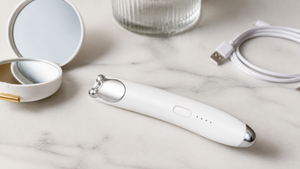

Staring at a screen for hours can leave the skin around your eyes looking tired, puffy, and creased in ways a concealer can't quite fix. Spa treatments offer one path, but they're expensive and hard to fit into a routine. A quieter option has been gaining attention: handheld devices that use gentle electrical currents and vibration to work on the eye area at home.
At the center of this category is microcurrent technology—a low-level current designed to mimic the body's own bioelectricity. When paired with sonic vibration, the approach targets both the surface and deeper layers of the skin. Here's what the combination actually does, where the evidence stands, and how to use it safely.
What Are Microcurrent Eye Massagers?
A microcurrent eye massager is a handheld device that delivers a very low-level electrical current to the skin around the eyes. The current is subtle—most people feel little more than a faint tingling—and it's designed to echo the body's natural bioelectric signals, according to KentDO™ Healthy & Beauty.
The proposed mechanism is that microcurrent may support ATP (adenosine triphosphate) production, a cellular energy currency. More ATP could, in theory, help the skin maintain proteins like collagen and elastin—two structural elements that keep the eye area looking firm. It's a hypothesis, not a settled fact, and the source frames it as a potential rather than a guarantee.
What distinguishes these devices from professional spa equipment is accessibility. In-office microcurrent treatments use higher intensities and require trained operators. At-home versions operate at a fraction of that power and are built for regular, gentle use on the delicate periorbital skin. They're non-invasive tools, not replacements for clinical procedures.
How Sonic Vibration Therapy Enhances the Treatment
Sonic vibration is the mechanical side of the equation—a rapid, oscillating movement that adds a different kind of stimulation. Where microcurrent targets cellular activity, vibration works on the surface and the muscles just beneath it.
The KentDO™ Healthy & Beauty source notes that massage and vibration can help with lymphatic drainage around the eyes. That matters because fluid buildup is a major contributor to morning puffiness and the shadowy look of under-eye bags. Vibration may also help skincare products absorb more readily by encouraging microcirculation.
There's a practical angle, too. After hours of squinting at a monitor, the tiny muscles around the eyes hold tension. Vibration offers a way to relax them—similar to how a massage can ease a stiff shoulder. The source reports that combining vibration with microcurrent may help with eye strain and the tired, heavy feeling that sets in by late afternoon. It's worth noting, though, that vibration alone isn't thought to provide the deeper cellular effects attributed to microcurrent.
What the Research Says About Microcurrent for the Eye Area
The available evidence for microcurrent eye devices is modest but suggestive. The KentDO™ source reports that regular use may help reduce the appearance of fine lines, crow's feet, and puffiness around the eyes. These improvements are attributed to the current's potential influence on cellular activity beneath the skin's surface.
That depth distinction matters when comparing microcurrent to topical creams. Creams sit on the epidermis and work primarily through hydration, occlusion, and active ingredients that penetrate the outermost layers. Microcurrent, by contrast, is said to reach deeper, potentially engaging the muscles and fibroblasts that influence skin structure. One doesn't replace the other—they address different levels of the problem.
But the research has limits. Most studies on microcurrent for facial aging are small, short-term, and often funded by device manufacturers. The source acknowledges that results can vary widely from person to person. Someone with mild puffiness may see a noticeable difference; someone with deeper wrinkles or significant volume loss may not. It's also unclear how long any improvements last once sessions are discontinued. The evidence points toward a temporary, maintenance-based effect rather than a permanent fix.
Safety and Precautions with Microcurrent Eye Devices
Microcurrent devices are generally low-risk when used correctly, but they're not for everyone. Standard safety guidance recommends avoiding them if you have a pacemaker or other implanted electronic medical device. The same goes for epilepsy, active eye infections, and conditions like glaucoma—where the electrical current or pressure from the device could pose a problem.
Conductive gel is non-negotiable. The gel creates a smooth interface between the device and your skin, preventing the dragging sensation that can cause irritation. Without it, the current won't distribute evenly, and you risk a scratchy, uncomfortable session. Most devices ship with a gel, and it's worth using exactly what the manufacturer provides.
Duration and frequency are set for a reason. The recommended session length is 10 to 15 minutes, used one to two times daily. Going longer or more often doesn't speed up results—it may just irritate the thin skin around the eyes. If you have a pre-existing medical condition or take medications that affect skin sensitivity, it's wise to check with a healthcare provider before starting.
How to Use a Microcurrent Eye Massager Effectively
Good technique makes a difference. A rushed session with dry skin can feel uncomfortable and won't do much. A consistent, unhurried routine, on the other hand, gives the device a fair chance to work. The source recommends 10 to 15 minutes per session, one to two times a day, and emphasizes that sticking with it over weeks is what tends to produce visible change—if it's going to happen at all.
Step-by-Step Usage Guidelines
Start with clean, dry skin. Any oil, makeup, or moisturizer left on the surface can interfere with conductivity and make the device less effective. Apply a thin, even layer of conductive gel over the under-eye area and the outer corners where crow's feet form.
Turn the device on and glide it gently along the under-eye area, moving from the inner corner outward toward the temple. Most devices have specific directional recommendations, so check the manual. Avoid pressing down—the weight of the device itself is usually enough contact. After 10 to 15 minutes, wipe away any remaining gel and follow up with your usual moisturizer.
Example Device: Tidesmit Microcurrent Eye Massager
The Tidesmit Microcurrent Eye Massager offers four modes that integrate microcurrent and sonic vibration therapy in a single handheld unit. Each mode adjusts the balance of electrical stimulation and mechanical oscillation, giving users some flexibility depending on how their eyes feel that day—puffy, fatigued, or just tight from screen time.
The device is designed to target eye fatigue, dark circles, and puffiness, though individual results will vary. The same 10-to-15-minute session guideline applies, and the manufacturer's instructions should be followed closely for the best experience. Having four modes means you can adjust the intensity, but the fundamentals—clean skin, conductive gel, and gentle movement—stay the same.
Frequently Asked Questions About Microcurrent Eye Massagers
What do studies suggest about microcurrent for eye wrinkles?
Sources indicate microcurrent may help reduce the appearance of fine lines and crow's feet by supporting cellular activity, but the evidence is limited and results vary from person to person.
Can microcurrent eye massagers help with dark circles?
The combination of microcurrent and sonic vibration is source-reported to aid lymphatic drainage, which may temporarily reduce puffiness and the shadowy look of dark circles.
Are there any side effects of using a microcurrent eye massager?
Mild redness or irritation may occur. Devices are not recommended for people with glaucoma, epilepsy, or pacemakers, and conductive gel should always be used to prevent skin friction.
