
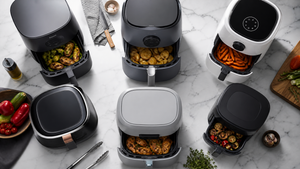

The air fryer category keeps expanding, but the gap between claimed capacity and what actually fits in the basket remains a recurring theme in 2026 lab reports. Choosing well usually means looking past wattage alone and paying attention to how a fryer handles a single serving, a full dinner, and the cleanup afterward.
The picks below draw from independent lab assessments by Consumer Reports and the Good Housekeeping Institute Kitchen & Cooking Lab. We did not run our own countertop tests; every performance claim in this guide is attributed to those published lab evaluations.
Why Trust These Air Fryer Reviews?
Both Consumer Reports and the Good Housekeeping Institute operate dedicated kitchen labs that measure cooking performance, capacity, ease of use, noise, and cleaning effort across multiple air fryer models. Their evaluations focus on repeatable, documented observations rather than marketing claims or short-term impressions.
The ratings and caveats in this article come from those labs, not from first-party testing. Consumer Reports provides product performance ratings and measured capacity data, while Good Housekeeping's Kitchen & Cooking Lab adds cooking quality, speed, and size guidance. Together they give a practical, source-based view of how each model performs in a real kitchen environment.
What to Look for When Buying an Air Fryer
Capacity is the first practical filter. A 1.7-quart Cosori Lite suits a single person or a small side dish, while a 6-quart Instant Vortex ClearCook can handle larger batches. Lab reports also show that actual measured capacity often comes in below the manufacturer's claimed number, so it helps to check independent measurements rather than relying on the box label.
Basket-style and oven-style fryers behave differently. Basket models generally shake food more easily and clean up with less effort, while air fryer toaster ovens add baking and toasting functions but can be harder to scrub, especially around the door and interior walls. Dual-basket designs add flexibility by letting you cook two foods at different temperatures simultaneously, though initial setup may take a few extra minutes.
- Capacity: Match the basket size to your typical batch; measured capacity may be smaller than claimed.
- Basket vs. oven: Baskets are easier to clean; oven-style models offer more cooking modes but have more surfaces to maintain.
- Features: Pre-programmed settings, clear windows, and dual baskets can improve convenience, while noise and temperature accuracy vary by model.
Noise levels and cleaning effort appear regularly in both labs' evaluations. A quieter model may matter more in an open kitchen, while dishwasher-safe baskets can make the difference between daily use and a countertop appliance that gathers dust.
Top Rated Air Fryers of 2026
This section highlights the best air fryers based on lab tests, organized by use case and budget, drawing from Consumer Reports and Good Housekeeping evaluations. Each entry focuses on what the sources actually observed, not a manufacturer's spec sheet.
Ninja Foodi DualZone Air Fryer
The dual-basket design stands out for cooking two foods at different settings simultaneously, which removes the need to run separate cycles for a main and a side. Consumer Reports rates its cooking performance and capacity well, though the initial setup can be tricky until you learn the control layout. Cleaning and noise attributes are generally in line with other large-capacity basket models, but the setup learning curve is the main friction point mentioned in lab notes.
Cosori Iconic Stainless Steel Air Fryer
Its stainless steel exterior gives it a more premium countertop look than plastic-bodied fryers, and the pre-programmed settings reduce guesswork for common foods. Lab assessments describe consistent performance and easy operation. Temperature accuracy is not flagged as a concern for this model in the sources reviewed; the temperature mismatch noted in 2026 testing involved a different Cosori model, the Dual Blaze, not the Iconic.
Instant Vortex ClearCook 6-in-1 Air Fryer
At $100 and with a 6-quart capacity, this model offers a strong value for households that cook in larger batches. Good Housekeeping's Kitchen & Cooking Lab found its cooking performance solid for speed and quality, and the clear viewing window lets you check browning without opening the basket and interrupting the cook cycle.
Chefman RJ38-2T
Each of its two baskets holds 1.8 quarts, so it works for cooking two small portions at different temperatures without taking up the footprint of a larger dual-basket fryer. The sources note the lack of included accessories as a potential drawback, meaning you may need to buy a separate rack or tray if you want more cooking flexibility. Lab notes do not place it at the top of the performance rankings, but its compact design earns attention for tight kitchens.
Cuisinart Air Fryer Toaster Oven
Source comparisons find that this toaster oven's air fry function performs comparably to a standalone air fryer, which gives it a real advantage if you want one appliance for baking, toasting, and frying. The trade-off is cleaning: the accessories are not dishwasher-safe, and air fryer toaster ovens tend to be harder to clean than basket-style models. The oven door and interior walls add surfaces that need manual attention after each use.
Philips Air Fryer 3000 Series
Lab-tested consistency and cooking quality are the main strengths here, supported by Philips' rapid air circulation design. The 3000 Series capacity suits small to medium households, making it a reasonable fit for one or two people who cook in moderate batches. The sources do not describe any standout convenience feature, but the reliable, even cooking keeps it in the conversation.
Ninja AF101 Air Fryer
A 4-quart basket keeps operation simple, and that is exactly the appeal for everyday use without layers of menus or presets. It is not the fastest or the most feature-rich model in this roundup, but it avoids the complexity of dual-basket or digital-heavy fryers. For crispiness and speed, the source observations lean toward basket-style fryers in general, and the AF101 sits comfortably in that category for basic meals.
Cosori Lite CAF-LI211
At 1.7 quarts, this is the smallest model featured here, and its light, compact design makes it easy to store or move between counter and cabinet. The small chamber concentrates hot air quickly for single servings or small snacks. Lab feedback suggests small-capacity fryers work well for one person, though they struggle with family-sized portions, so it is best treated as a secondary or single-serve appliance.
Browse Our Air Fryer Collection
If you want to compare current prices, colors, and available configurations, browse our air fryer collection. It includes many of the reviewed models and additional options that may fit different counter spaces, budgets, and cooking styles.
Air Fryer Comparison: Key Specs and Differences
The table below summarizes the main differences among the top models, using only source-reported strengths and documented caveats. Measured capacity is included where the labs provided an actual number; a dash means the source did not report a measured value for that model.
| Product | Best For | Source-Reported Strength | Caveat | Measured Capacity |
|---|---|---|---|---|
| Ninja Foodi DualZone | Cooking two foods at once | Dual-basket flexibility | Tricky initial setup | — |
| Cosori Iconic SS | Style-conscious kitchens | Stainless steel, easy use | None flagged | — |
| Instant Vortex ClearCook | Large batches on a budget | Clear window, 6-quart value | None flagged | 6 quarts |
| Chefman RJ38-2T | Compact dual cooking | Two 1.8-quart baskets | No accessories included | 1.8 quarts per basket |
| Cuisinart Air Fryer Toaster Oven | Multi-function baking/frying | Comparable to standalone fryer | Accessories not dishwasher-safe | — |
| Philips 3000 Series | Consistent small-medium batches | Reliable cooking quality | No standout convenience feature | — |
| Ninja AF101 | Simple everyday use | Straightforward 4-quart design | Not the fastest model | 4 quarts |
| Cosori Lite CAF-LI211 | Singles or small snacks | Ultra-compact footprint | Tiny capacity limits batch size | 1.7 quarts |
Two discrepancies stand out in the 2026 lab data. The Instant Vortex Plus 140-3079-01 measured 3 quarts in testing despite a manufacturer claim of 4 quarts, and the Cosori Dual Blaze ran hotter than set, measuring 363°F at a 350°F setting. These mismatches illustrate why independent measurement matters when comparing models.
Basket-style fryers are generally easier to clean than oven-style models, a pattern repeated across both sources. Oven-style fryers add toasting and baking versatility but bring more interior surfaces and often non-dishwasher-safe accessories, which shifts the convenience calculation depending on how often you plan to use the extra functions.
Cooking Tips and Usage Guidance
Preheat the air fryer before adding food when the recipe calls for it, and arrange items in a single layer with some space between them. Overcrowding the basket traps steam and slows browning, which lab observations tie to less consistent texture. Shaking or flipping halfway through the cook cycle helps even out hot spots.
Presets like the Ninja Air Fryer XL's Air Fry setting at 390°F for 20 minutes can serve as a starting point, but treat them as estimates. The source notes that some models run hotter than the dial indicates, so checking food a few minutes early prevents overcooking. Cleaning routines matter too: many basket-style fryers have dishwasher-safe baskets, but Cuisinart toaster oven accessories are not dishwasher-safe and need hand washing.
Frequently Asked Questions About Air Fryers
Are glass air fryers safer than nonstick models?
Some people choose glass to limit exposure to nonstick coatings like PTFE or PFAS, but neither lab source confirms that glass is safer. It is a consumer preference based on material concerns, not a proven safety ranking.
How much oil do air fryers use compared to deep frying?
Air fryers use significantly less oil than deep frying, according to the source data. That reduced oil usage is a practical advantage, though the sources do not frame it as a specific health guarantee.
Do air fryers use convection or infrared heating?
Most air fryers use convection, meaning a fan circulates hot air around the food. Some models, including certain T-fal options, use infrared heating elements instead, but convection remains the standard in this 2026 lineup.
