

Why Wireless Charging Matters Today
Wireless charging delivers a truly frictionless power‑up: you simply set a phone, watch or earbuds on a Qi‑compatible pad and electricity flows instantly, eliminating the need to fumble with cords or locate a wall outlet. This effortless act removes the tangled mass of cables that typically crowd nightstands, desks and travel bags, creating a cleaner visual environment and freeing up valuable space. In humid kitchens, bathrooms or busy office desks, the absence of exposed metal connectors reduces the risk of short‑circuits, electric shocks and corrosion that can degrade ports over time. Because the charging interface is sealed, devices stay protected from moisture, dust and accidental pulls. Beyond convenience and safety, wireless chargers curb electronic waste: a single multi‑device station replaces dozens of individual chargers and disposable cables, cutting the volume of plastic and copper that would otherwise end up in landfill. By lowering demand for new accessories, the technology also trims the carbon footprint associated with manufacturing, packaging and shipping, making it an environmentally responsible choice for today’s connected households. Adopting this smart charging solution also simplifies daily routines, letting users focus on living rather than managing power.
Convenient, Cable‑Free Charging Experience
Wireless charging turns a simple placement into a power‑up: just set a Qi‑ or Qi2‑enabled device on a pad and charging begins automatically, eliminating the need to plug in a cable. Modern pads use magnetic alignment—Apple’s MagSafe and the newer Qi2 standard to snap phones, watches and earbuds into the optimal spot, guaranteeing reliable energy transfer even if the device is slightly off‑center. This magnetic “snap‑in” also speeds up the process, as the charger can deliver up to 25 W to compatible smartphones such as the iPhone 17 series or Google Pixel 10 Pro XL, reducing charge time to under an hour. The combination of place‑and‑charge simplicity, auto‑detect start, precise magnetic positioning, and high‑power fast charging creates a tidy, hassle‑free charging hub that fits seamlessly on nightstands, desks, or integrated furniture.
Universal Compatibility Across Devices
Wireless charging hinges on the Qi standard, which has become the de‑facto global protocol for inductive power transfer. Because Qi is open‑source and overseen by the Wireless Power Consortium, any manufacturer that builds a Qi‑compliant coil can charge on the same pad, giving consumers true cross‑brand support for Apple iPhones, Samsung Galaxy phones, Google Pixel, Xiaomi, OnePlus and a host of other smartphones. The same standard also powers earbuds, smartwatches, and even emerging automotive charging pads, allowing a single charger to service multiple gadget families. The next‑generation Qi2 specification adds magnetic alignment—mirroring Apple’s MagSafe—and higher power outputs up to 25 W, ensuring that today’s devices charge quickly while future models can be accommodated without swapping hardware. This universal compatibility simplifies home and office setups, reduces cable clutter, and future‑proofs users against the rapid turnover of device ecosystems.
Extending Device Lifespan
Wireless chargers eliminate the constant cycle of plugging and unplugging a cable, which is a primary cause of wear on device ports. Each connection can damage the tiny metal contacts, and over time this leads to loose connections, intermittent charging, or complete port failure. By keeping the device on a Qi‑compatible pad, the port remains untouched, preserving its mechanical integrity for years. In addition to protecting the port, wireless charging keeps dust, moisture and even corrosion out of the charging interface. A closed port is less likely to accumulate particles that could cause short‑circuits or degrade the connector, a benefit especially valuable in humid Irish homes.
Modern wireless chargers embed safety chips that automatically cease power delivery once the device reaches 100 % charge, preventing over‑charging. Temperature regulation sensors monitor heat buildup and throttle power if the device becomes too warm, further shielding the battery from stress. Over‑charge protection, foreign‑object detection, and built‑in temperature control work together to maintain optimal charging cycles, extending both battery health and overall device lifespan. These combined safeguards make wireless charging a durable, low‑maintenance solution for smartphones, earbuds, smartwatches, and other Qi‑enabled gadgets.
Aesthetic and Space‑Saving Benefits
Wireless charging pads turn nightstands, desks and kitchen counters into tidy, clutter‑free zones by eliminating the tangle of cables and individual adapters. Modern chargers are built with slim, low‑profile silhouettes that blend seamlessly with the clean lines of contemporary Irish interiors, often using neutral colours and subtle materials that complement minimalist décor. Many models are foldable or compact enough to slip into a travel bag, making them ideal for small apartments or frequent trips without sacrificing style. Multi‑device stations further streamline the space by consolidating power for smartphones, earbuds, smartwatches and even tablets onto a single platform, replacing several brick‑like chargers with one elegant hub.
Environmental Advantages
Wireless charging directly tackles electronic waste by eliminating the tangle of individual cables and adapters that would otherwise be produced, shipped, and discarded. When a single Qi‑ or Qi2‑compatible pad can power a phone, earbuds, smartwatch, and even a tablet, the total number of plastic connectors needed in a household drops dramatically, cutting the carbon footprint associated with manufacturing those components. Many of the newest stations are certified by the Global Recycled Standard (GRS), guaranteeing that at least 50 % of their housing material comes from recycled plastics or post‑consumer waste, further reducing the demand for virgin resin. Modern chargers also incorporate smart power‑management chips that sense when a device is fully charged, automatically shutting off power to prevent standby draw and overheating. This intelligent regulation not only protects battery health but also saves energy on a daily basis, translating into lower overall electricity consumption for homes and offices. Together, these advances make wireless charging a greener alternative that shrinks e‑waste, lowers emissions, and promotes more sustainable consumer habits.
Safety and Reliability
Modern wireless chargers are built to meet stringent safety standards that protect both devices and users. Certifications such as CE, FCC, RoHS and the Wireless Power Consortium (WPC) verify that chargers comply with European Union electromagnetic‑compatibility rules, restrict hazardous substances, and meet rigorous performance criteria—critical for Irish households that must follow EU safety directives. Most reputable pads include over‑temperature protection, foreign‑object detection, and short‑circuit safeguards that automatically cut power if the device overheats, a metal object is detected, or a fault occurs, preventing fire hazards. Magnetic alignment, featured in Qi2 and Apple MagSafe chargers, not only speeds up charging by snapping the device into the optimal spot but also reduces the risk of accidental slips that could expose live contacts. Together, these certifications and built‑in safety features ensure a reliable, hazard‑free charging experience across a wide range of smartphones, earbuds, smartwatches and other Qi‑enabled gadgets.
Multi‑Device Charging Solutions
Modern multi‑device charging stations combine convenience, speed, and portability. 3‑in‑1 and 5‑in‑1 pads can power a smartphone, smartwatch, earbuds and even a tablet or laptop simultaneously, using Qi or Qi2 standards that work across Apple, Samsung, Google and other brands. Integrated USB‑C Power Delivery ports let the same dock supply up to 100 W to laptops and accessories, turning a single countertop unit into a full‑featured charging hub. For on‑the‑go users, portable power‑bank chargers embed a wireless pad and a USB‑C output, enabling cable‑free charging while traveling or during outdoor activities. Foldable designs—such as the Anker MagGo or Amazon‑listed 3‑in‑1 magnetic chargers—collapse into a compact shape that fits nightstands, office desks or travel kits, while magnetic alignment ( MagSafe or Qi2) guarantees proper positioning and efficient energy transfer. These stations reduce cable clutter, protect device ports from wear, and support a cleaner, more minimalist aesthetic in homes and offices.
Smart Home Integration
Wireless charging is increasingly becoming a smart‑home feature. IoT‑enabled chargers can be linked to voice assistants such as Alexa, Google Assistant, or proprietary apps, letting users start or stop charging, set schedules, and receive status notifications without touching a button. Many modern stations include energy‑monitoring chips that report real‑time power draw, allowing homeowners to optimise consumption by charging only when electricity rates are low or by throttling power during peak usage. High‑power Qi2 pads – especially those delivering 25 W or more – may require dedicated circuits or panel upgrades to avoid overload, a recommendation echoed by electricians in the smart‑power literature. Finally, designers are embedding wireless pads directly into furniture, countertops, and wall panels, creating seamless charging zones that blend with minimalist interiors while keeping devices powered and ready for use.
Future Trends and Emerging Technologies
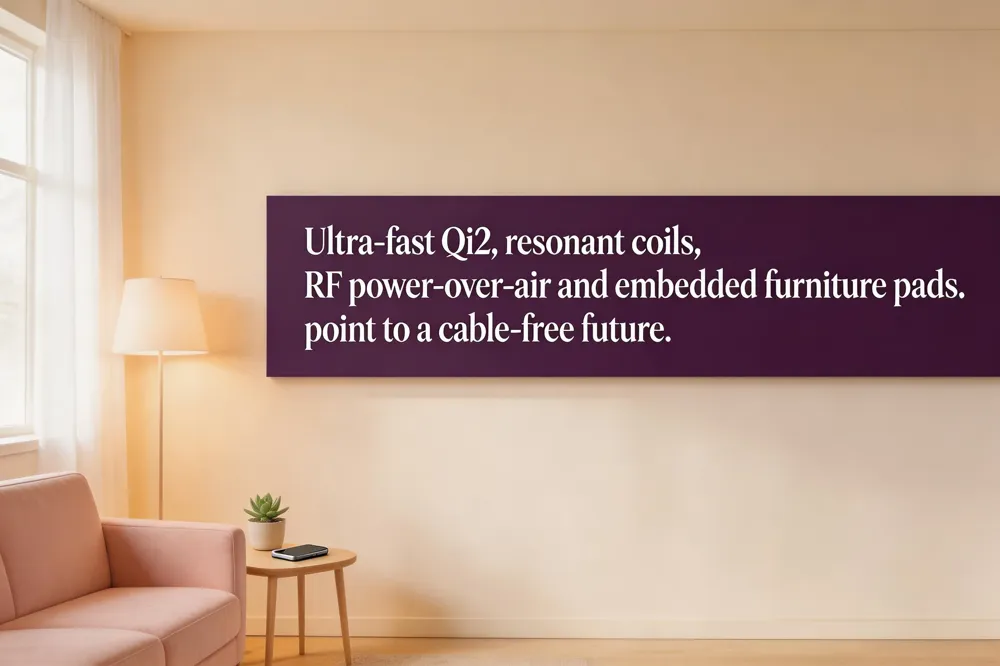
The next wave of wireless power will be driven by ultra‑fast Qi2 magnetic pads that can push 25 W into compatible phones, delivering roughly 50 % of a battery in just 30 minutes—enough to top up an iPhone 17 or Google Pixel 10 Pro while you sip coffee. Beyond inductive pads, resonant and emerging‑the‑air (RF) solutions are emerging for short‑distance, multi‑device power: resonant coils can energise a phone, smartwatch and earbuds placed within a few centimeters of a transmitter, while RF systems promise true over‑the‑air charging across room‑scale zones for low‑power gadgets. Smart furniture is already embracing this trend, with countertops, nightstands and kitchen surfaces built‑in Qi/Qi2 pads that blend seamlessly into décor and feed power through the furniture’s wiring. Looking further ahead, wireless EV charging pads for home garages are being prototyped, using high‑power magnetic resonance to replenish an electric car’s battery without a cable. Together, these advances point to homes where power is delivered invisibly, safely and efficiently, reducing clutter and extending device lifespans.
Future‑Ready Homes with Seamless Power
Wireless charging is becoming a daily habit: users simply place a phone, watch, earbuds or earbuds a a aable thePhone with any, phone begins charging without cables. Qi‑ and Qi2‑compatible pads, especially those with magnetic alignment like MagSafe, guarantee the device snaps into the optimal spot, making the process frictionless. In a smart home, these chargers can be linked to voice assistants or energy‑management hubs, allowing users to schedule charging during off‑peak hours and monitor power draw via an app. Because the pads draw less standby power than multiple wired adapters, they support household energy‑saving goals while keeping work‑spaces tidy. Over time, the reduction of repeated plugging and unplugging protects charging ports, extending the lifespan of smartphones, earbuds and smartwatches. Fewer cables also mean less electronic waste, and many modern stations are built from recycled materials and meet RoHS/CE standards. Together, seamless convenience, smart‑home integration, and durability make wireless charging a cornerstone of sustainable, future‑ready living.
