
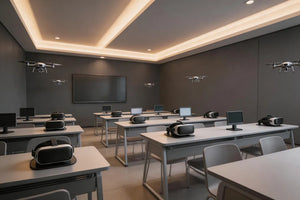

Why Immersive Tech Matters in Modern Schools
Students today crave hands‑on, experiential learning that bridges theory and real‑world application. Immersive technologies such as virtual reality and drones deliver exactly that, letting learners explore 3‑D environments, conduct aerial surveys, and practice skills safely. Ireland’s Digital Skills for Education strategy (2023‑2026) earmarks funding to embed these tools in schools, recognizing their power to boost engagement, STEM competence, and inclusive access for diverse learners. Tidesmit supports this vision by offering unlocked, 5G‑compatible smartphones that serve as inexpensive controllers for both VR headsets and consumer‑grade drones. The devices integrate seamlessly with classroom management platforms, enable rapid content streaming, and meet GDPR requirements, making them a cost‑effective, scalable bridge between policy and practice for schools across the country and future generations today.
VR Glasses: Boosting Engagement and Retention
How does VR improve student focus and memory? Studies cited by ClassVR (PwC) report a four‑fold increase in student focus and a four‑fold boost in knowledge‑retention speed. Immersive presence triggers emotional fidelity and active learning, leading to deeper encoding of information. The brain treats virtual experiences like real‑world actions, so learners retain concepts longer and with higher confidence.
What hardware options are realistic for Irish schools? Meta Quest 3 standalone headsets cost about $500, offer mixed‑reality, 6DoF tracking, and 5G‑compatible streaming—ideal for schools with Ireland’s high‑speed broadband. ClassVR’s Xplorer and Xcelerate headsets are curriculum‑aligned, used in over 90 countries, and include teacher‑management portals. Knoxlabs’ K‑12 kits ship pre‑configured Meta Quest 3S EDU devices with hygiene packs, secure charging stations, and mobile‑device‑management integration, simplifying deployment.
Inclusive design for SEND learners VR platforms provide multi‑sensory environments, adjustable audio‑visual cues, and calming or stimulating settings so tailor experiences for neurodivergent students and those with physical disabilities. Customizable interfaces and haptic feedback support diverse learning needs.
Practical classroom management tips Adopt shared headset models, schedule short 10‑15 minute sessions, and use classroom‑management portals to monitor usage. Provide clear setup guidelines, on‑demand technical support, and hygiene protocols to keep sessions comfortable and safe for all learners.
Drones in STEM: From Theory to Real‑World Data
Integrating drones into K‑12 curricula turns abstract physics, geography and coding concepts into tangible experiences. In physics lessons students feel lift, thrust and aerodynamics by piloting drones, while aerial imagery feeds GIS mapping and 3‑D modelling projects that reinforce geometry and spatial reasoning. Geography units use drone‑captured data for topographic surveys, and coding classes employ block‑coding platforms such as DroneBlocks to program autonomous flight paths, linking algorithmic thinking with real‑world outcomes.
Program examples illustrate these ideas in action. Volatus Aerospace’s Youth Drone Camp (YDC) offers 2‑ to 4‑day camps that teach safety, piloting, photography and engineering design to up to 96 learners. The MYdrone program (grades 5‑8) guides 60‑100 students through aerial data collection and 3‑D school modelling. For seniors, the SEAR initiative engages grades 9‑12 in community‑focused sustainability projects using drones and machine‑learning analysis.
Cost‑effective pathways include starting with micro‑drones under 250 g (US $200‑$300) for indoor use, sharing larger consumer drones (e.g., DJI Mini 3 Pro) across classes with a 5‑to‑7 student‑to‑drone ratio, and leveraging EU grant funding or Volatus partnerships. Safety certification follows FAA TRUST guidelines and can be embedded in lesson plans, ensuring responsible operation while keeping expenses low.
Synergising VR and Drones for Mixed‑Reality Learning
Combining 360° drone footage with VR headsets creates a seamless mixed‑reality loop: students launch a drone, capture aerial video, then upload the footage to a classroom‑managed VR platform for repeated, on‑demand exploration. This workflow lets learners revisit the same scene from any angle, reinforcing spatial reasoning and boosting retention—studies report up to a 30 % gain when VR is paired with active data interaction.
Case studies illustrate the power of this approach. Irish secondary schools have used drone‑captured 360° tours of the Giant’s Causeway, allowing pupils to walk the cliffs in VR and then annotate geological features. Engineering simulations in UK academies let students fly drones over a bridge model, import the flight path into VR, and test stress‑analysis scenarios without physical prototypes.
Data capture and feedback loops close the learning cycle. Sensors on drones log flight metrics, while VR headsets record gaze, duration, and quiz responses. Teachers receive real‑time analytics that highlight misconceptions, enabling targeted reteaching and measurable improvement across the four pillars of immersive learning: presence, theory, data science, and spatial design.
Professional Development and Technical Support
Managing dozens of headsets and drones securely requires a robust mobile‑device‑management (MDM) framework. Platforms like ArborXR, Knoxlabs MDM, and the ClassVR portal enable bulk provisioning, automated firmware updates, usage monitoring, and role‑based access controls, aligning with district data‑governance and cybersecurity policies. These systems also integrate curriculum‑alignment tools, allowing teachers to deploy pre‑approved lesson modules, track student progress, and generate analytics for data‑driven instruction. Together, comprehensive PD and centralized device management create a sustainable ecosystem where immersive learning can thrive without compromising safety, security, or instructional quality.
Budget‑Friendly Procurement with Tidesmit
Tidesmit helps schools stretch every euro by turning everyday unlocked smartphones into dual‑purpose controllers for VR headsets and drone pilots, eliminating carrier‑specific fees and costly dedicated devices. The platform offers bulk‑purchase discounts and 0 % APR financing on Knoxlabs VR kits and drone packages, while free worldwide delivery to over 200 countries removes shipping overhead. All hardware complies with GDPR, ensuring student data stays protected across the EU. Schools can therefore acquire complete immersive‑learning ecosystems—Meta Quest 3S EDU headsets, drone kits, and the smartphones that run them—through a single, transparent sourcing channel, keeping total spend low and simplifying procurement logistics.
Sustainability and Future‑Ready Skills
What environmental benefits do VR and drones offer?
Virtual reality eliminates the need for physical field trips, cutting travel‑related carbon emissions and reducing the school’s carbon footprint. By streaming 360° experiences and immersive simulations, VR supports UN SDG 13 (Climate Action) while delivering high‑impact lessons that align with UN SDG 4 (Quality Education). Drones complement this by gathering aerial data remotely, replacing fuel‑intensive site visits with sensor‑based surveys that lower overall energy use. Together, VR and drones create a sustainable learning ecosystem that teaches students to analyze real‑world datasets, apply AI‑driven analytics, and solve interdisciplinary problems—preparing them for data‑rich, AI‑enabled workplaces of the future.
Measuring Impact and Scaling Success
Performance metrics for immersive technology focus on three data pillars: engagement, knowledge retention, and spatial‑reasoning gains. Analytics dashboards record usage time, attention indices, and assessment outcomes, allowing schools to quantify impact. Studies have shown a 27 % increase in spatial‑reasoning test scores and a 275 % boost in learner confidence when applying VR‑derived concepts, confirming the technology’s instructional value.
Feedback loops are built directly into VR platforms. Real‑time dashboards surface metrics such as session length, interaction density, and sentiment scores, enabling teachers to adjust pacing and content on the fly. Post‑session surveys feed into the same system, creating a closed loop that informs curriculum refinement and professional‑development planning.
Scalable models for multi‑academy trusts and ministries rely on shared‑headset ecosystems (e.g., ClassVR Xplorer, Knoxlabs VR kits) combined with mobile‑device‑management (MDM) for provisioning, updates, and hygiene tracking. Districts can mitigate costs by securing grant funding, partnering with providers like CDW for bulk procurement, and leveraging centralized support contracts. This approach delivers consistent, data‑driven VR experiences across schools while preserving budgetary sustainability.
A Vision for Irish Classrooms
Drones and VR glasses together create a powerful, immersive learning ecosystem. Drones give students hands‑on experience with physics, geography, data analysis and coding, while VR glasses turn abstract concepts into 3‑D, interactive experiences that boost engagement, retention and confidence. By pairing aerial data with virtual field trips, pupils explore real‑world environments safely and sustainably, supporting Ireland’s digital‑learning strategy and SDG goals. Tidesmit is committed to making these tools affordable and ready for every school, offering unlocked smartphones, affordable headsets and consumer‑grade drones with free worldwide delivery and GDPR‑compliant support. We invite Irish primary‑ and secondary‑school leaders to launch pilot programmes, harnessing immersive technology to prepare learners for a future‑ready, innovative Ireland.
