
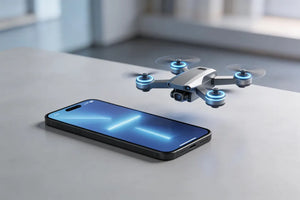

Why Drones Meet VR Today
The global drone market is exploding, with estimates of $44.5 billion in 2025 and a projected $209.9 billion by 2030, driven by regulatory breakthroughs such as the FAA’s Part 108 BVLOS rules and the EU’s U‑space traffic‑management framework. At the same time, VR hardware has become mainstream: standalone headsets now deliver 200‑220° fields of view, 90 FPS low‑latency tracking, and eye‑tracking for foveated rendering, making immersive experiences comfortable and affordable. This convergence creates a powerful synergy. High‑resolution 360° and multispectral cameras mounted on drones capture aerial data that can be streamed in real time to VR glasses, turning a simple flight into a first‑person cockpit view. Real‑time object‑detection AI highlights points of interest, while swarm‑drone light shows can be rehearsed and experienced entirely in VR before the actual event. In agriculture, farmers walk through 3‑D VR visualisations of crop health; in emergency response, commanders explore VR reconstructions of disaster zones. The blend of rapid drone market growth, advanced VR headsets, and seamless aerial‑to‑immersive pipelines is reshaping tourism, real‑estate, inspection, and entertainment, turning what used to be a niche novelty into a mainstream workflow.
1. 360° Drone‑Live Streams for Outdoor Adventure VR
Drone‑mounted 360° cameras have turned outdoor adventures into immersive VR spectacles. By stitching together a full‑sphere video feed in real time, these drones deliver a live, stereoscopic stream that a VR headset renders as if the viewer were perched on the aircraft itself. The result is a true first‑person perspective that lets users look around mountains, forests, or coastlines simply by moving their head, dramatically boosting situational awareness and emotional engagement.
How do 360° camera drones enable immersive outdoor VR experiences? A drone equipped with a 360° camera captures a spherical video feed that is transmitted live to a VR headset. The user sees the scene as if they were on board, allowing true first‑person navigation of mountains, forests, or coastlines, which dramatically boosts situational awareness and enjoyment.
What hardware is best for this use‑case? Standalone headsets such as Meta Quest 3 or HTC Vive Pro with low‑latency Wi‑Fi and 5G connectivity, paired with DJI FPV Combo or Mavic 3 Pro drones, provide the needed bandwidth and resolution for smooth 8K‑or‑better streams. Together they enable hands‑free piloting, edge‑AI object detection, and low‑latency interaction for a seamless outdoor VR experience.
2. First‑Person Drone Piloting with VR Glasses
Edge AI on the drone processes video, lidar and thermal data in real time, performing obstacle detection and object tagging locally. Only essential metadata and alerts are streamed to the headset, cutting latency and eliminating reliance on continuous cloud links. This ensures pilots receive timely visual cues—such as highlighted points of interest or hazard warnings—while navigating BVLOS routes, fulfilling regulatory safety standards and enhancing mission efficiency.
3. Real‑Time Object Detection for VR Tourism Tours
AI‑driven point‑of‑interest tagging is transforming VR tourism by letting drones automatically recognize and label landmarks as they fly over heritage sites. High‑resolution 360° cameras capture the scenery, while onboard edge‑AI identifies statues, arches, ancient walls, and natural formations. When the video stream reaches a VR headset, users can select highlighted icons to hear audio guides, view historical facts, or see AR overlays, turning a passive view into an interactive, educational experience.
This technology is especially powerful for promoting Irish tourism. The EU Drone Strategy 2.0 and Ireland’s National Drone Strategy (2023‑2026) provide grants for projects that merge UAV imaging with immersive VR, enabling virtual tours of iconic locations such as the Cliffs of Moher, the Ring of Kerry, and historic castles. These initiatives help showcase Ireland’s cultural heritage to a global audience, boost visitor numbers, and support local economies.
How can AI object detection improve VR tourism? Drones scan landmarks and automatically label features—such as statues, arches, or natural formations—using AI. When streamed to a VR headset, users can click highlighted points to receive audio guides, historical facts, or AR overlays, making tours more engaging.
What Irish initiatives support this? The EU Drone Strategy 2.0 and Ireland’s National Drone Strategy (2023‑2026) fund projects that combine UAV imaging with VR experiences, helping promote sites like the Cliffs of Moher to global audiences.
4. Swarm‑Based Light Shows in Virtual Reality
The market for drone light‑shows is expanding rapidly. Forecasts indicate the segment will reach $6.52 billion by 2032, driven by a growing demand for environmentally friendly alternatives to traditional fireworks and a appetite for immersive, high‑tech entertainment experiences. As urban venues and large‑scale festivals adopt drone‑based spectacles, VR‑based choreography tools become essential for efficient planning, cost reduction, and flawless execution.
5. Precision Agriculture Visualised in 3‑D VR
Multispectral imaging drones now fly over Irish fields, gathering vegetation‑index data such as NDVI and EVI across the visible and infrared spectrum. On‑board processing converts these raw bands into calibrated reflectance maps, which are then uploaded to cloud platforms that stitch the mosaics into a georeferenced 3‑D model of the farm. In a VR headset, the farmer walks through a lifelike digital replica of the crops, where colour‑coded heat‑maps instantly highlight stress zones, irrigation gaps, or pest infestations. This immersive "crop‑health simulation" lets agronomists explore problem areas from any angle, compare historical scans, and plan targeted interventions without stepping onto the ground.
The technology’s rapid adoption in Ireland is underpinned by EU Green Deal funds and the Irish National Drone Strategy (2023‑2026), which award grants to startups developing autonomous UAVs and VR‑compatible data pipelines. These subsidies cover sensor integration, edge‑AI for real‑time analytics, and the creation of user‑friendly VR interfaces for precision‑farming.
How do multispectral drones feed VR platforms for farmers? They capture spectral indices, transform them into 3‑D VR landscapes, and overlay stress indicators so farmers can virtually walk their fields and pinpoint issues instantly.
What funding supports this technology in Ireland? EU Green Deal financing and the Irish National Drone Strategy provide grants for autonomous UAV research, enabling the development of VR‑ready precision‑farming solutions.
6. Emergency‑Response 3‑D Reconstructions in VR
Real‑time 3‑D mapping: Drones equipped with LiDAR, photogrammetry cameras, and thermal sensors fly over disaster zones, instantly stitching point clouds and high‑resolution imagery into immersive 3‑D models. These models are streamed to VR headsets, giving commanders a virtual walkthrough of collapsed buildings, flooded streets, or wildfire fronts without stepping into hazardous areas.
VR situational awareness: By donning VR glasses, rescue teams can explore the reconstructed environment at scale, toggle layers (e.g., heat signatures, gas leaks), and pinpoint critical hotspots. The first‑person perspective improves depth perception and spatial understanding, enabling faster route planning and resource allocation.
Disaster‑zone assessment: Integrated AI processes the incoming sensor data on‑board, automatically tagging structural damage, detecting blocked roads, and highlighting potential survivors. These AI‑generated overlays appear in the VR scene as visual cues, allowing operators to prioritize interventions and reduce decision latency.
What role does VR play in drone‑based disaster response? Drones capture terrain data, generate 3‑D models, and stream them to VR headsets, where commanders can safely explore, identify hazards, and plan rescue routes.
How does AI enhance this workflow? Edge AI tags damage, flags obstacles, and marks survivors, feeding actionable overlays into the VR system to accelerate decision‑making.
7. Hands‑Free Filmmaking with VR‑Controlled Drones
VR headsets combined with handheld‑controller drones give filmmakers a true first‑person cockpit view while keeping hands free to adjust altitude, speed and camera angle. A director wearing a Meta Quest 3 can pilot a DJI Mavic 3 Pro or Air 3S, both equipped with 5K video and industry gimbals, and instantly see the shot through a 360° live feed. This immersive perspective makes it possible to compose cinematic sequences that were previously limited to costly helicopter rigs or static aerial shots.
Because the controller is independent of the headset’s display, creators can focus on framing, motion parallax and lighting in real time, tweaking parameters without looking away from the scene. The result is smoother, more dynamic footage that captures unique angles and fluid movements, enhancing storytelling.
Industry adoption is accelerating: production houses are integrating VR‑assisted drones into storyboarding pipelines, and advertising agencies use them for rapid location scouting and live‑event coverage. The workflow reduces setup time and post‑production effort, driving a surge in demand for VR‑compatible drone platforms and cementing their role in modern cinematic production.
8. VR‑Enabled Real‑Estate Walk‑Throughs
Drone‑mounted 360° cameras are now a staple of Irish property marketing. A high‑resolution aerial sweep captures every façade, garden and neighbourhood street, while a ground‑level 360° tour stitches interior rooms into a seamless VR experience. Prospective buyers put on a headset—often an Oculus Quest or similar device—and can walk through the living room, peek out the kitchen window, or fly above the roof, all from the comfort of their sofa. This dual‑perspective approach boosts situational awareness and cuts the need for multiple physical viewings, saving time for agents and buyers alike.
The most common workflow combines Matterport’s 3‑D scanning platform with VR headsets. Matterport’s photogrammetry creates a detailed mesh of the property, which is then streamed to the headset for an immersive walkthrough. Agents embed the VR tour on their websites or share a link via email, allowing anyone with a compatible headset to explore the home instantly.
In Ireland’s competitive property market, where listings in Dublin and coastal towns often attract international buyers, these VR‑enabled tours have become a differentiator. They enable remote investors to assess a home’s layout, light quality and surrounding amenities without travelling, accelerating decision‑making and reducing the costs associated with repeated on‑site visits.
9. Infrastructure Inspection in Virtual Reality
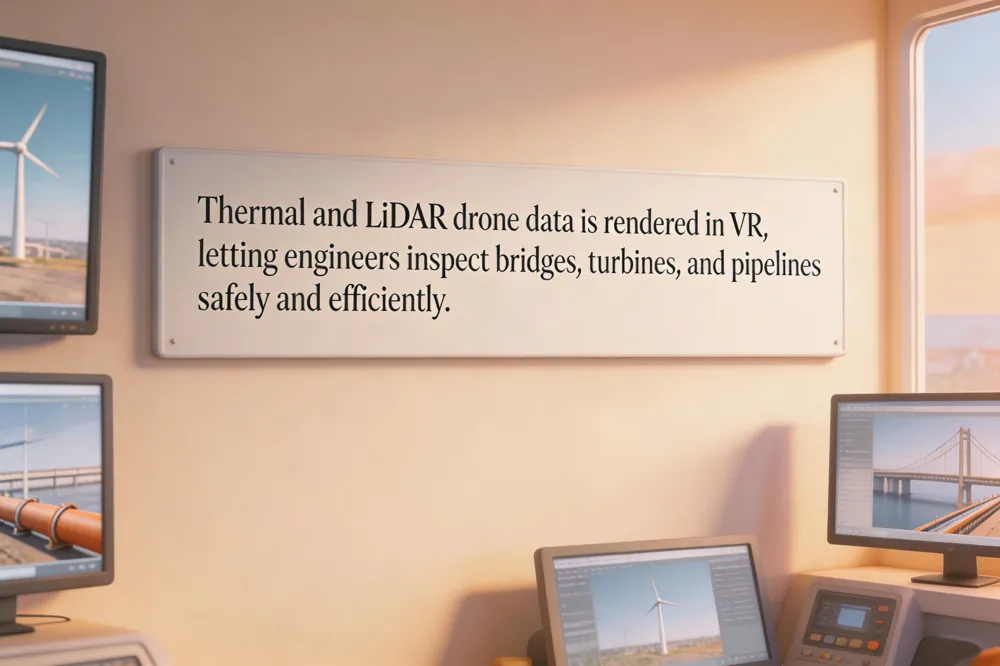
Thermal and LiDAR sensors mounted on modern drones now capture high‑resolution heat maps and dense 3‑D point clouds of bridges, wind turbines, power lines, and pipelines in a single flight. The data are streamed to a cloud platform where edge‑AI cleans and stitches the measurements, then feeds them into a VR engine. Engineers don VR headsets and walk through a fully immersive, life‑size replica of the asset, hovering around bolts, blades, or conductors to spot overheating, corrosion, or structural deformations without ever climbing the structure. This virtual walkthrough reduces inspection time, lowers safety risk, and enables simultaneous multi‑disciplinary review—mechanical, electrical, and civil teams can annotate the same scene in real time. The new EU U‑Space traffic‑management (U‑TM) framework supports this workflow by allocating dedicated BVLOS airspace corridors for inspection drones, enforcing Remote‑ID and detect‑and‑avoid standards, and simplifying permit acquisition. With U‑TM corridors in place, operators can launch longer endurance flights, gather richer datasets, and deliver VR visualisations to engineers faster, accelerating maintenance decisions and ensuring regulatory compliance across the European market.
10. Drone‑Delivered Logistics Visualised in VR Command Centres
How does VR improve drone delivery logistics? VR headsets let operators step into a virtual control centre where a live 3‑D map displays every delivery drone in real time. Integrated edge‑AI streams payload status, battery health, and weather data directly into the headset, enabling instant route adjustments and collision avoidance. By visualising a fleet’s positions and performance in an immersive environment, planners can optimise delivery corridors, reduce idle flight time, and enhance safety for urban BVLOS operations. The result is higher throughput and lower operational costs for logistics providers.
What role can Tidesmit play in this ecosystem? Tidesmit can act as the one‑stop shop for Irish businesses seeking VR‑enabled drone logistics. By bundling standalone VR headsets (e.g., Meta Quest 3) with compatible delivery platforms such as FlyCart‑100, Tidesmit offers a turnkey solution that leverages Ireland’s nationwide 5G coverage and the EU Drone Strategy 2.0 compliance framework. The e‑commerce site can also provide training modules, subscription‑based VR dashboard licences, and after‑sales support, helping local retailers and SMEs adopt immersive logistics without building the technology stack from scratch.
11. The Business Landscape: Market Size, Regulation, and Opportunities
The global commercial UAV market is on a steep upward trajectory. IDTechEx projects the sector to swell from US$69 billion in 2026 to US$147.8 billion by 2034, a growth driven by BVLOS approvals, AI‑based autonomy, and expanding use cases in agriculture, inspection, and logistics. Parallel to this, the virtual‑reality market has already broken the $200 billion barrier (Citigroup, 2019) and continues to expand across hardware, networks, and content, especially in non‑gaming domains such as education, healthcare, and retail.
Regulatory frameworks are shaping how drone‑VR integrations can scale, particularly in Ireland. The Irish Aviation Authority mandates registration for drones over 250 g and enforces the Drone Strategy 2.0 for digital infrastructure, which includes the U‑space traffic‑management system. Across the Atlantic, the U.S. FAA’s forthcoming Part 108 rules will formalise routine BVLOS flights, setting a global benchmark that Irish firms can adopt to unlock cross‑border services.
For Tidesmit, these dynamics present a clear strategic opening. By bundling VR‑compatible drones (e.g., DJI Mavic 3 Pro) with its e‑commerce platform, the company can serve growing demand in tourism, real‑estate, and industrial inspection, while leveraging EU subsidies for agri‑tech and the Irish National Drone Strategy to fund R&D. The convergence of a booming UAV market, rapid VR adoption, and supportive regulation positions Tidesmit to become a leading provider of immersive aerial solutions in Europe and beyond.
Future‑Ready Immersion for Irish Consumers
Tidesmit, Ireland’s leading e‑commerce platform, has already begun curating a selection of VR‑ready drones and headsets, positioning itself as a one‑stop shop for technology. By partnering with manufacturers such as DJI and emerging Irish startups, the company offers the FPV Combo, Mavic series and 360° camera drones that stream directly to Meta Quest 3 or HTC Vive, allowing users to pilot the aircraft from a first‑person view or enjoy aerial tours of the countryside. This product mix arrives at a moment when Irish shoppers are showing heightened interest in experiential tech: searches for “VR headset for drone” spiked in late 2025, and tourism boards are promoting previews of sites like the Cliffs of Moher. As battery life improves, edge‑AI reduces latency, and 5G coverage expands across the island, the barrier to entry drops, making aerial experiences affordable for hobbyists and small businesses alike. Consumers are invited to explore the catalogue, test demo videos, and join Tidesmit’s upcoming webinar series that showcases how VR‑enabled drones can transform travel, real‑estate and storytelling in Ireland.
